Compare Roche lobe radii
Compare Roche lobe radii across mass ratios with Eggleton's formula and an ellipsoid approximation.
Use the component mass ratio qi, the same convention as Eggleton, and the named radii point, back, side and pole:
>>> from math import log
>>>
>>> import rocheometry
>>>
>>> def eggleton(q):
...     return 0.49 * q ** (2 / 3) / (0.6 * q ** (2 / 3) + log(1 + q ** (1 / 3)))
>>>
>>> print("     q   R_vol  Eggleton  point  back   side   pole   ellipsoid")
     q   R_vol  Eggleton  point  back   side   pole   ellipsoid
>>>
>>> for q in (0.001, 0.01, 0.1, 1.0, 10.0, 100.0, 1000.0):
...     lobe = rocheometry.ComponentGeometry(q).lobe()
...     r = lobe.volume_radius()
...     point, back, side, pole = (
...         lobe.named_radius(name) for name in ("point", "back", "side", "pole")
...     )
...     error = 100 * (eggleton(q) / r - 1)
...     ellipsoid = (point + back) / 2 * side * pole / r**3
...     print(
...         f"{q:6g}  {r:.4f}  {error:+.2f}%"
...         f"   {point / r:.3f}  {back / r:.3f}  {side / r:.3f}  {pole / r:.3f}"
...         f"  {ellipsoid:.3f}"
...     )
 0.001  0.0482  +0.31%   1.404  1.223  0.944  0.904  1.121
  0.01  0.1012  +0.76%   1.397  1.169  0.949  0.912  1.111
   0.1  0.2054  +0.67%   1.375  1.112  0.961  0.924  1.105
     1  0.3799  -0.25%   1.316  1.066  0.985  0.938  1.100
    10  0.5803  -0.37%   1.236  1.058  1.027  0.921  1.085
   100  0.7182  +0.29%   1.195  1.092  1.083  0.875  1.084
  1000  0.7817  +0.46%   1.193  1.139  1.136  0.841  1.114
To plot the shape against mass ratio:
>>> import matplotlib.pyplot as plt
>>>
>>> qs = [10 ** (k / 10) for k in range(-30, 31)]
>>> names = ("point", "back", "side", "pole")
>>> ratios = {name: [] for name in names}
>>>
>>> for q in qs:
...     lobe = rocheometry.ComponentGeometry(q).lobe()
...     r = lobe.volume_radius()
...     for name in names:
...         ratios[name].append(lobe.named_radius(name) / r)
>>>
>>> fig, ax = plt.subplots()
>>>
>>> for name in names:
...     _ = ax.plot(qs, ratios[name], label=name)
>>> _ = ax.axhline(1.0, color="0.6", linewidth=0.8)
>>> _ = ax.set(xscale="log", xlabel="component mass ratio", ylabel="radius / R_vol")
>>> _ = ax.legend()
>>> plt.close(fig)
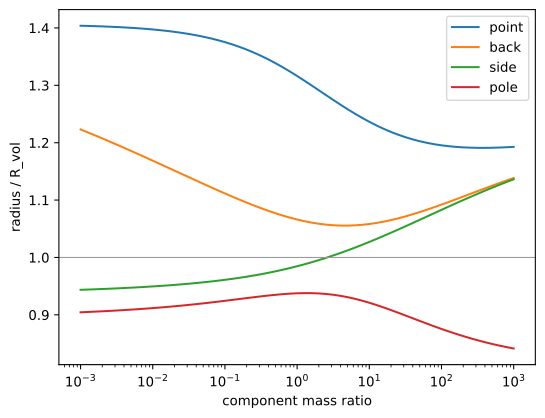
R_vol is in units of the separation, and the four radii are divided by it.
Eggleton's formula stays within 1% of the volume radius across the tabulated mass ratios.
The radius towards the companion is 20–40% longer than the volume radius, and the polar radius 6–16% shorter.
The last column is the ellipsoid's volume divided by the lobe's, using semi-axes (point + back)/2, side and pole.
It is 8–12% too large in these cases: the lobe tapers to a point at L1, and point exceeds back by up to a quarter.
Ellipsoidal models, such as the biaxial spheroids of EBOP-family light-curve codes, are best kept to components well inside their lobes.